Your website needs to do more than just display products — it needs to build trust, create excitement, and make buying as easy as possible. Small changes can make a big difference when it comes to increasing online conversion rates. At Float, we work with hundreds of merchants across more than 10 industries, giving us access to a wealth of data on what actually drives conversions. We’ve seen firsthand how small tweaks — like adding videos or social proof — can lead to big results.
1. Use Video Content on Your Product Pages
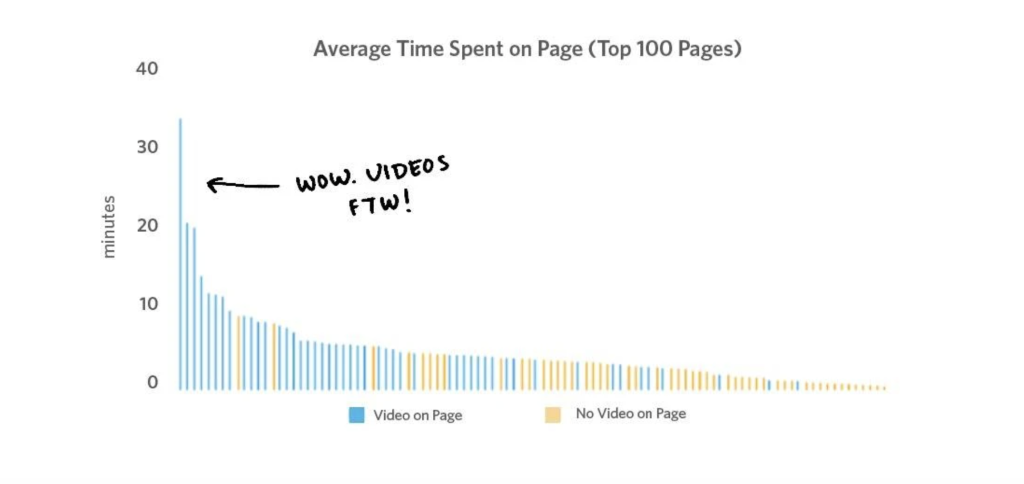
You’re selling more than just a product. You’re selling an experience and a feeling, and communicating that online on a screen can be difficult. People stay on average 2.6 times longer on a page if there is a video on it.
Your videos don’t need to be complex. Short videos of your products will give the products more life and show off what is hard to see in a photo.
Kolmio Jewellery does a great job of using videos to show their luxury pieces like these bold everyday gold huggies. (Which you can Float the payment for!)
Your videos don’t have to be taken by a professional videographer. A nice photography board and a phone will do a great job for most products. Once you’ve gotten the hang of adding simple short videos, there are more advanced strategies to look into, such as:
Unboxing Videos
Customers will discover exactly what comes in the box, showcasing the physical product and accessories. It’s a chance to show some brand personality like with this unboxing of Man Crates.
Product Demo Videos
By using a product video such as this on your eCommerce site, you make it easier than ever for customers to get a full range of the product’s most prominent features, making it more comfortable for them to go ahead and make a purchase. Research done by Invesp showed that 74% of users who watched an explainer video about a product subsequently bought it.
Honey Baby Naturals does a great job of this with their campaign featuring their customer (A kid) as the one promoting the brand’s conditioner for curly hair.

How-To Videos
Product demonstrations and “how to” videos can be highly effective at giving customers the knowledge they need to use the product, while also offering them peace of mind before the purchase.
2. Use Social Proof Throughout Your Website
Social proof is the idea that people tend to conform to the behaviour and opinions of others in their social group in order to be accepted and liked.
Social proof works by tapping into the basic human instinct to follow the actions of others, building trust and credibility and lowering barriers to purchasing online.
Essentially, it’s borrowing third-party influence to sway potential customers.

Reviews
Not all reviews are equal.
Reviews and testimonials are a form of social proof. However, not all reviews are equal, and the impact of reviews should not be underestimated.
- A written review on a website is good.
- A written review on a website with a person’s name is better.
- A written review on a website with a person’s name and photo is even better.
- A video review from a person is the best you can get.
Other Forms of Social Proof
The above would be actioning a social proof/review strategy, but the video form will lead to significantly higher results.
There are many ways to use social proof on your website. Increasing the conversion rate using social proof means using many types of social proof, not just reviews. Here are some examples of social proof on e-commerce websites:
Show Your Bestsellers
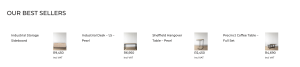
Use social proof product badges to signal which products sell best or which products are preferred by specific groups or customers. For example, Pedersen & Lennard have shown which products people inside the company — who know the products best — recommend.

Leverage Your Expertise and Herritage
The Ardmore “Celebrating 40 Years” badge is a form of longevity-based social proof, reinforcing trust by showcasing the brand’s decades of experience. It signals reliability, expertise, and a strong reputation, making customers feel more confident in purchasing.

Use Stats and Customer Numbers
Ahrefs is a great example of a site using social proof to reinforce the idea that they are the brand everyone is going with. Here, Ahrefs leverages real-time customer data to create a sense that you are missing out by not signing up.

3. Use Float to Allow Customers to Make Big Purchases Accessible
We’ve all been there — staring at something we really want but convincing ourselves it’s out of reach. Whether it’s a dream bike, premium luggage, or that statement furniture piece, the wishlist keeps growing.
With Float, those wishlists turn into reality. By offering a smarter way to pay, you open the door for more customers to shop now instead of someday. It’s not just about affordability — it’s about access.
And the results speak for themselves. Since partnering with Float in 2023, merchant’s like Cycle Lab have seen order values increase by a massive 754%. More flexibility means more customers checking out, not just adding to their cart.
4. Give Customers the Confidence to Click ‘Buy’
The difference between a customer buying and wanting to buy is not always as big as we might imagine. Our job as web designers is to understand what questions, objections, and tasks the user has in their mind as they come to the website and then to ensure we provide them with the information to achieve that.
This can be done by:
- Being clear about shipping and return information. Don’t make it difficult for the user to find this information.
- Providing clear information to any frequently asked questions.
- Providing all the information specifications.
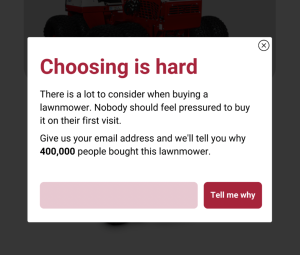
At times, increasing conversion rate may not mean converting new users the first time they land on your site. Rishi Rawat highlights this with his insight into buying lawnmowers. As he says, people don’t buy lawnmowers on their first visit. They research. Compare. Think it over. That’s what makes this pop-up so brilliant.
Increase Your E-commerce Conversion Rate with Float
Improving your e-commerce conversion rate doesn’t require a complete website overhaul. Small but strategic changes — like adding product videos, leveraging social proof, and making checkout seamless — can significantly impact customer trust and purchasing decisions.
At Float, we’ve worked with retailers to increase their conversion rates and average order value. We know what it takes to help our merchants grow. Discover other Float merchant success stories: Samsung, The Pro Shop, Cycle Lab.
Are you a UK merchant? Interested to hear how you, too, can lift your business with Float? Fill out our merchant application form here or reach out to our expert team at grow@choosefloat.com, today.